Dies ist eine alte Version des Dokuments!
Pure polymers
A thorough knowledge of the material parameters and the behaviour of the material are vitally important to be able to obtain results.
In order to describe the behavior of the polymers, the following properties must be examined:
- Rheological properties (shear viscosity)
- Thermodynamic properties (crystalline melting / glass transition temperature, heat capacity, specific enthalpy, thermal conductivity)
- Density (specific volumes, bulk density, solid material density)
- Size of the pellet granule
Rheological Material Parameters
The behavior of the flow of the fluids is described using the law:
$$τ=η\cdot\dotγ$$
with the shear stress $τ$, viscosity $η$ and shear rate $\dotγ$.
Constant viscosities are usually found only for very small and very high shear rates for polymer melts. More often polymer melts show a pseudo-plastic behavior, which can be described using the power law according to Ostwald and de Waale.
$$τ=K\cdot\dotγ^n$$
Here, $n$ is the exponent of the flow law (n‹1) and $K$ is the consistency factor.
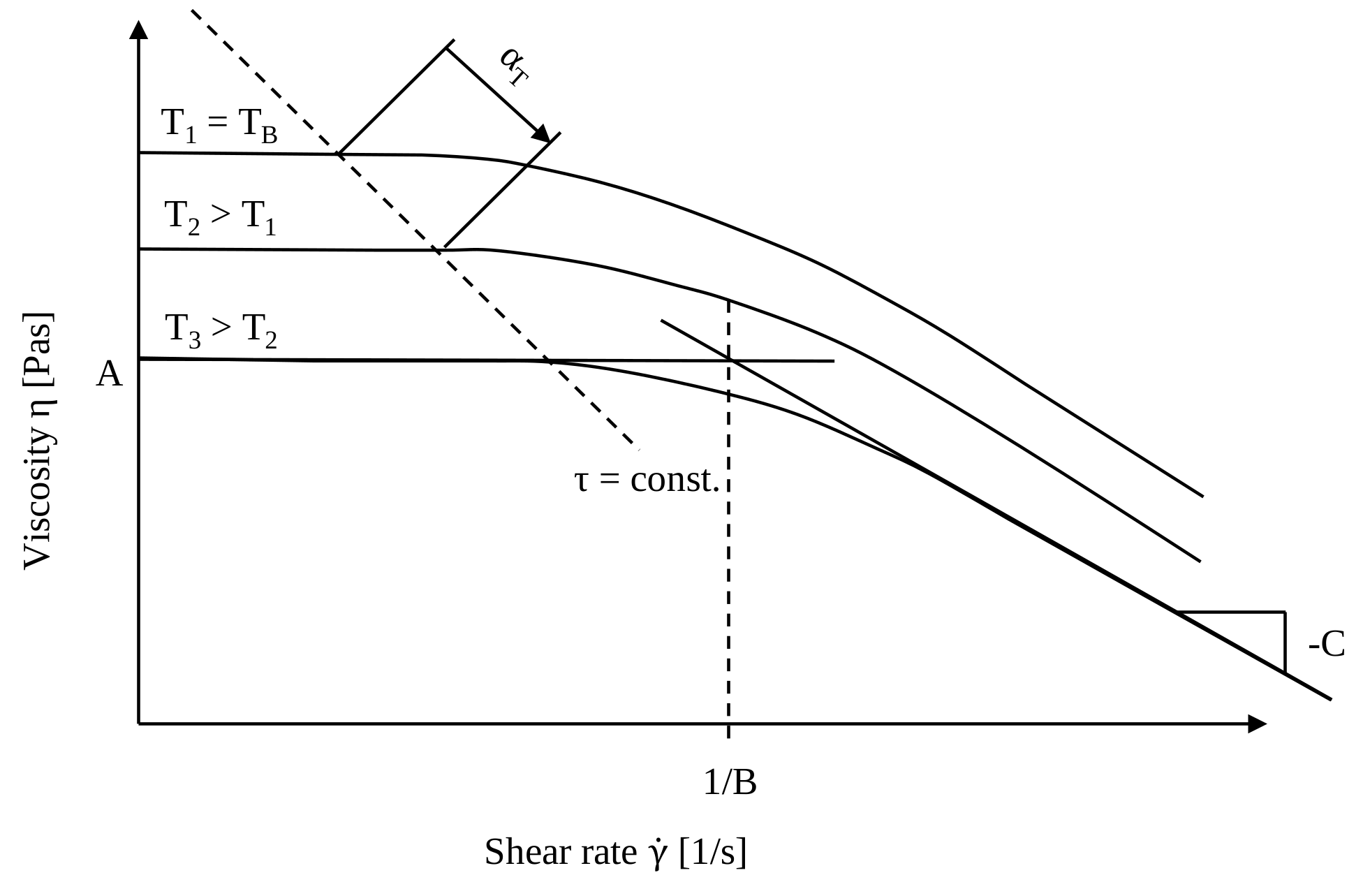
In double logarithmic scale, the viscosity over the shear rate yields a linear pro-file with gradient ($n-1$).The gradient of this straight line is dependent on the shear rate, therefore for the value of $n$ shear rate ranges must always be given. In addition to this the independent shear rate with zero viscosity cannot be described using the power flow law. This difficulty can be solved using the Carreau equation.
The simulation programmes REX / PSI / SIGMA offer two equations to describe the rheological behavior, firstly the Carreau–WLF (Williams, Landel-Ferry) equation and secondly the Carreau-Arrhenius equation. The equations differ in that they offer different descriptions for the dependence of the temperature on the viscosity. This difference was introduced so that data from different origins (CAMPUS; BAYMAT; VISCOSITY) are able to be entered without conversions. The evaluation of the viscosity function with the Carreau-estimation program offers not only the zero viscosity $a$, but the reciprocal transitional shear rate $b$, the gradient $c$, the reference temperature $T_b$ and the standard temperature $T_s$ which are necessary for the following equation:
WLF approach:
$$log(a_T) = \frac {C_1\cdot(T_B-T_S)} {C_2+(T_B-T_S)} - \frac {C_1\cdot(T-T_S)} {C_2+(T-T_S)}$$
with: $C_1$ = 8.86, $C_2$ = 101.6, $T_B$ = reference temperature, $T_S$ = standard temperature ($T_S ≈ T_G + 50°C$), $T$ = current temperature
The WLF equation provides a better description than the Arrhenius approach, especially for amorphous polymers whose molten state begins at a temperature slightly above the glass transition temperature. This assumes that the segment mobility of polymers near the glass transition temperature is primarily determined by the free volume, which increases approximately linearly with the distance from the glass transition temperature TG. It is assumed that the segment mobility of polymers near the glass transition temperature is predominantly determined by the free volume, which increases approximately linearly with the distance from the glass transition temperature TG [Ferr80]. If a temperature approximately 50°C above the glass transition temperature $T_G$ is selected as the standard temperature $T_S$, the parameters $C_1$ and $C_2$ in the equation can be regarded as material-independent.
Alternatively, the following approach can also be used:
$$ln(a_T) = - \frac {C_1 \cdot (T-T_B)} {C_2+(T-T_B)}$$
with: $T_B$ = reference temperature, $T$ = current temperature, $C_1$ = adjustment constant, $C_2$ = adjustment constant
can also be used.
The Arrhenius approach, which is also available, is:
$$ln(a_T)=\frac{E}{R} (\frac{1}{T+273.15}-\frac{1}{T_B+273.15}) $$
where: $T_B$ = reference temperature, $T$ = current temperature, $E$ = activation energy, $R$ = universal gas constant
Measuring Series with the High Pressure Capillary Rheometer
In order to be able to define the necessary Carreau parameters, measurements have to be taken, for instance, with the high-pressure capillary rheometer. Usually the experimental series are performed at 3 different temperatures.
In a high-pressure capillary rheometer, pre-heated material flows through a capillary with a circular cross-section. During this process, the total area of the important viscosities is measured. For low viscosity fluids, long thin capillaries are used and for high viscosity fluids appropriately high pressures are used. By using this discontinuous method, the necessary pressure is made available through carrier gas, gravity or by means of pistons. The volume flow rate is constant at a constant piston speed. The pressure gradient at the inlet and at the outlet is not constant due to vortex formation as a result of viscoelastic effects (Bagley-Correction), due to the change of the flow speed (Hagenbach-Correction) and due to the variation of the friction at the wall (Couette-Correction). To calculate the exact viscosity of the polymer melt, the pressure gradient is measured using two pressure sensors on a designated length in the capillary, because here are simple rheological flow relationships.
Thermodynamic Material Parameters
The calculation of both the melting behavior and the temperature development in power melts requires a comprehensive knowledge of the thermodynamic material behavior. The thermodynamic properties are dependent on both pressure and temperature and show a different material property in the solid state and in the melt state.
The following data is required for REX / PSI / SIGMA: the crystalline melting temperature, glass transition temperature, specific heat capacity and specific enthalpy. These can be detected using the DSC (Difference Scanning Calorimetric)- analysis.
General Principle of the DSC-Analysis
The principle is based on the measurement of the heat flow between one specimen and a comparable substance in a twin calorimeter. The sample and the reference substances are arranged symmetrically to each other so that the temperature difference is zero. Many chemical and physical transitions like melting, crystallisation, oxidation or decomposition of a substance are related to a heat flow i.e. changes in enthalpy appear. These enthalpy changes are detected by the DSC-analysis with regard to their position in the temperature range and their calorimetric magnitude. The specific heat and the enthalpy as a function of temperature can be quantified very quickly and very easily. The measurement principle is shown in the following figure.
 PLATZHALTER ABBILDUNG 89: Prinzip eines Differenz-Wärmestrom-Kalorimeters