Inhaltsverzeichnis
Installation and Uninstallation
Preliminary Notes and Important Information
If you are using PAM < 2.0, please contact support in advance: software@ktp.upb.de.
If PAM 2.0 or higher is already installed, any existing PAM installation must be uninstalled before reinstalling. Note: The material databases will be retained unless you delete or overwrite them manually.
With PAM 3.0, structural changes were introduced to the material database. Therefore, local and network databases from earlier versions must first be migrated to PAM 3.0. A detailed description can be found in the section Migration of an old PAM database.
If you are working with a network database that has already been migrated to PAM 3.0 or higher, all users must update the PAM software to the same major version in order to continue working with this database.
Firebird
PAM uses the relational DBMS Firebird. In order for PAM to access a database, the required Firebird components must be installed on the computer.
Dongle Driver
The appropriate driver must be installed in order to detect the license dongle (Sentinel Hasp HL). Installer: HaspUserSetup.zip
The following requirements must be met for installing and operating PAM:
| Database Server | Requirement | Notes |
|---|---|---|
| Operating system | Windows 11 (64-bit) | |
| Database | Firebird 5.0.4 (port 3050/TCP) | If you are still using Firebird 2.5.9, please update it. |
| Additional software components | none | |
| Required permissions | Administrator rights | required for installation/firewall/service configuration |
| PAM Client | Requirement | Notes |
|---|---|---|
| Operating system | Windows 11 | |
| Additional software components | 1) Firebird Client/Server 5.0.4 (x64) 2) HASP Sentinel dongle driver (Sentinel LDK / HASP Runtime) | Firebird components Dongle driver |
| Required permissions | User rights (operation), administrator rights (installation) |
Note: If the PAM client is to use a local database, the database server requirements also apply additionally: local Firebird service, local port/firewall configuration, and administrator rights for setup.
Uninstalling an Existing PAM Version
1. Close PAM, including any open database connections.
2. In Windows: select the existing PAM version under Settings > Apps > Installed Apps or in the Control Panel.
3. Run Uninstall.
4. Important: Database files, such as *.gdb/*.fdb, are not removed.
Installing PAM
1. Run the setup, preferably by right-clicking and selecting “Run as administrator”.
2. Select the language:
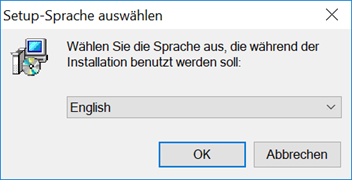
3. Complete the installation wizard.
4. Install Firebird ( Firebird components).
5. Install the dongle driver ( Dongle driver).
6. Start PAM and configure the database connection, either local or network.
Migration of an Old PAM Database (Version < 3.0)
Requirements
Advanced / administrative rights are required for the migration.
Please note:
- During the migration, the affected material database must not be opened by other programs/users, such as SIGMA, REX, PSI, or Flame Robin.
- If the migration is started while another user is still connected, an error message appears:
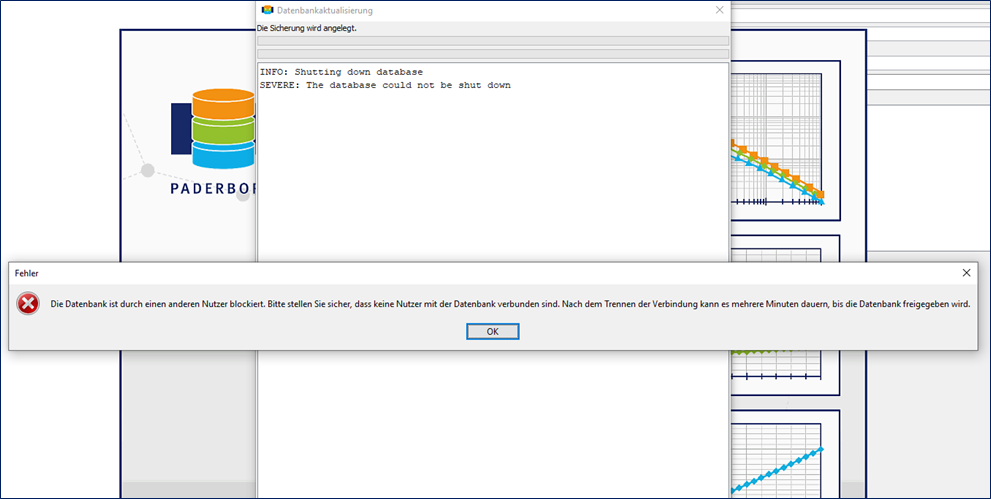
Migration Procedure
When you open a database from an older version, such as 2.x, in PAM 3.0, an information dialog appears:

1. Make sure that there are no further connections to the database.
2. Click “Update” to start the migration.
3. PAM automatically creates a backup version of the old database in compressed format.
 Typical storage location:
 ''C:\Users\<User>\AppData\Roaming\KTP\PAM2.1\backups\''
 File name according to the following pattern:
 ''<DB-name>-<backup-date>-<ID>''
4. PAM then performs the database migration. After successful completion, the log may look like this:
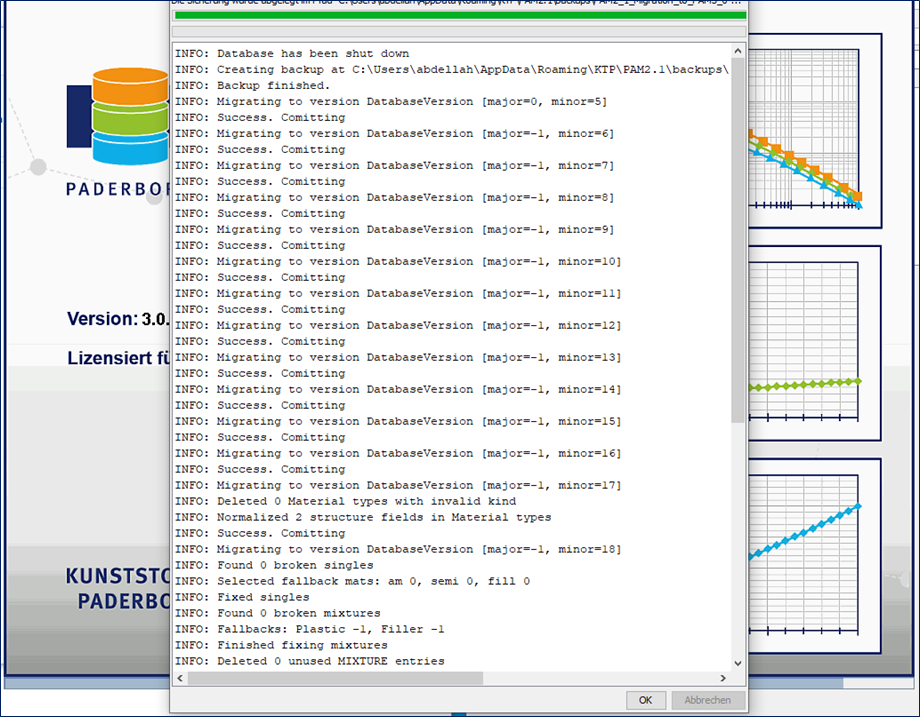
Restoring a Backup Database (gbak)
The backup file is stored in a compressed format that cannot be read directly. To restore it, use the Firebird tool gbak.
Example:
gbak -r -user SYSDBA -password <Password> "<Path_to_backup_file>" "<Path_to_target_database.fdb>"
Notes:
- gbak is located in the Firebird installation directory under
…\bin\. - Make sure to use correct quotation marks for paths containing spaces.
- The target path should point to a writable directory.
Upgrading a Material Database from 3.0 to 3.1
PAM 3.1 provides new functions that require an adjustment of the database structure. When connecting to a database in format 3.0, the following notice is displayed:
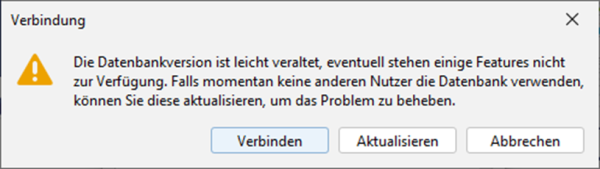
You can still select “Connect”, but not all functions may be available. Recommendation: Update the database to the current format (v3.1) using “Update”.
Important notes:
- If using a shared network database, make sure that no other users are connected.
- Administrative rights are required for the update.
- Perform the update only if the required permissions are available and no other users are affected.
Installing a PAM Database on a Server (Network Operation)
Scenario: PAM stores the material data on an internal server. Users should primarily have read access, while only administrators should have write access.
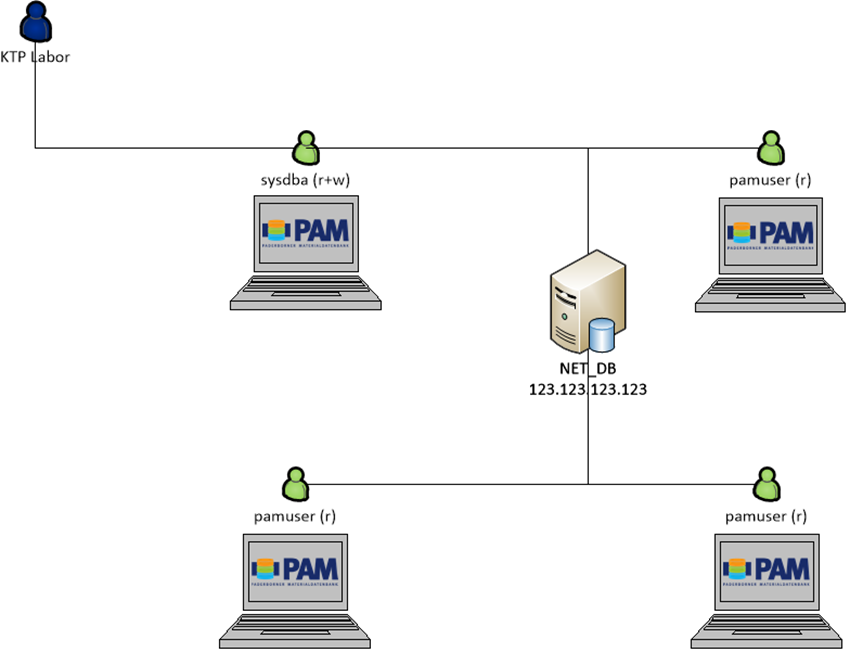
Preparing the Infrastructure (Server)
- Note the server IP, for example 123.123.123.123
- Install the Firebird Server with administrator rights according to the following guide.
- Copy the PAM database file to the server, for example:
- Target path:
C:\data\pam\PAM.GDBor *.fdb
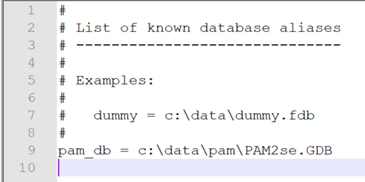
- Set the Firebird alias on the server:
- Open the file
C:\Program Files\Firebird\Firebird_5_0\databases.confwith administrator rights - Add the alias. It must match the target path exactly:
- Example:
pam_db = C:\data\pam\PAM2se.GDB
- Add a firewall rule on the server:
- Option A, recommended: allow inbound TCP port 3050
- Option B: allow the program
…\Firebird_5_0\firebird.exe - Enable access at least for Private/Domain according to your company policy
Setting Up the Network Database in PAM (Client)
On each PAM client:
1. Open PAM 2. Menu: File → Databases 3. In Database Management, click “Add” and enter the data:
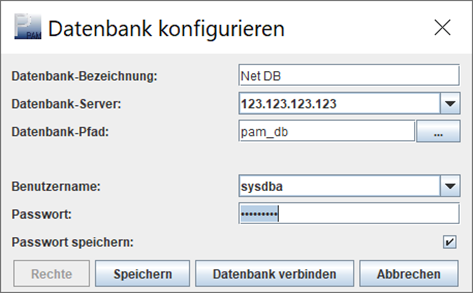
Recommended fields:
- Database name: freely selectable, for example “PAM-DB Net”
- Database server: server IP or hostname
- Database path: alias from
aliases.conf, for examplepam_db - User name / password: initially often
sysdba/masterkey; recommendation: change the password later
4. Click “Connect database”.
Users and Permissions on a PAM Network Database
Often, only certain users should be allowed to write data records, while other users should have read-only access.
User management is performed server-side in Firebird. An administration tool such as Flame Robin can be used for this: flamerobin.org
Step 1: Register the database in Flame Robin
Menu: Database → Register existing database…
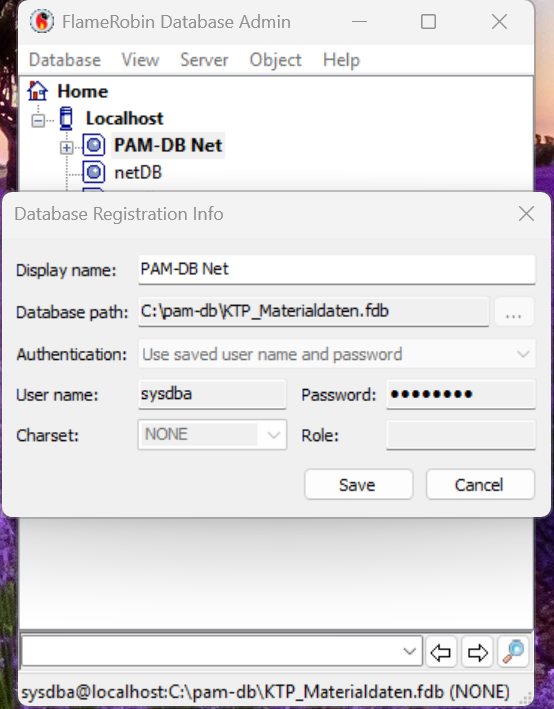
- Display name: freely selectable
- Database path: path to the database file or alias path, depending on the setup
- Authentication: stored user/password
- User: sysdba (admin)
- Password: corresponding admin password
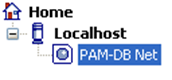
After successful registration, the database appears in the tree view:
Step 2: Create users and change the SYSDBA password
Menu: Server → Manage users…
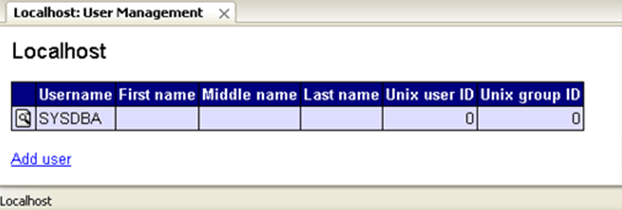
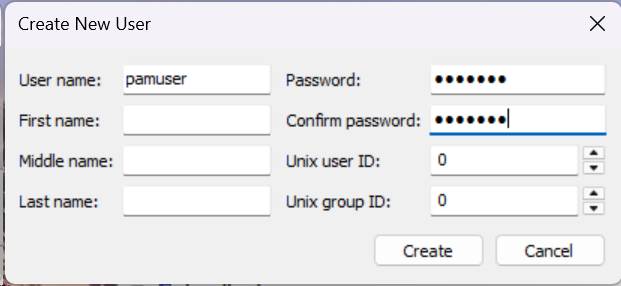
Create a new user:
- Select “Add user”
- Set the user name, for example
pamuser, and password:
Change the SYSDBA password (recommended):
- Select SYSDBA and open “Modify user”
- Set a new password:
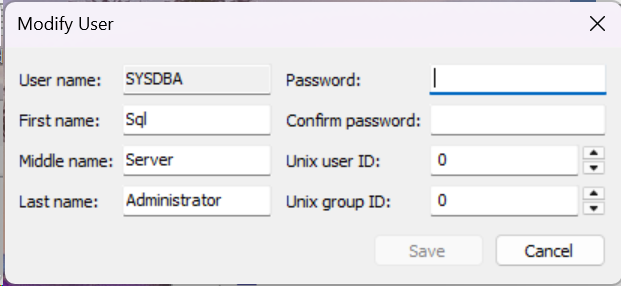
Important: The new password must then be used in PAM for the database connection.
Client: Entering the Network Database with New Login Credentials
In PAM: File → Databases → Add
- Server: hostname or IP
- Database path: alias, for example
pam_net_db
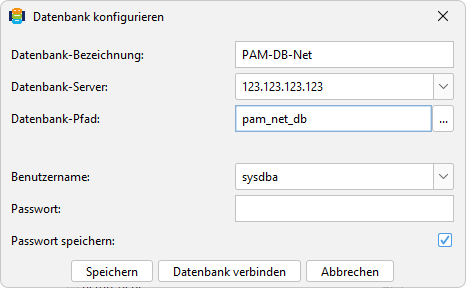
If the SYSDBA password has been changed, it may be necessary to confirm that a connection can no longer be established with the default password.
Startup Problems / Troubleshooting
Database Connection Fails
Possible causes:
- Port 3050/TCP has not been opened in the firewall, on the server and possibly also on the client.
- The Firebird service is not running on the server.
- The user does not have write permissions for database migration/update.
If an error message appears during automatic extension/migration, connect once as the database administrator:
- User: sysdba
- Password: masterkey, unless it has been changed
Dongle Problems
If the dongle driver is installed, diagnostics can be performed via the Sentinel Admin Control Center:
- Open browser:
https://localhost:1947
Log
PAM logs program behavior in the folder
%APPDATA%\KTP\PAM2.1\pamlog.0.0.log
.
Note on Database Migration at Program Startup
- Old material databases are usually extended automatically the first time a connection is established (PAM 2.2+).
- Starting with PAM 3, the migration wizard starts automatically when an old database version is detected.
- If write permissions are missing, a corresponding error message appears. In this case: connect once as sysdba and perform the migration.